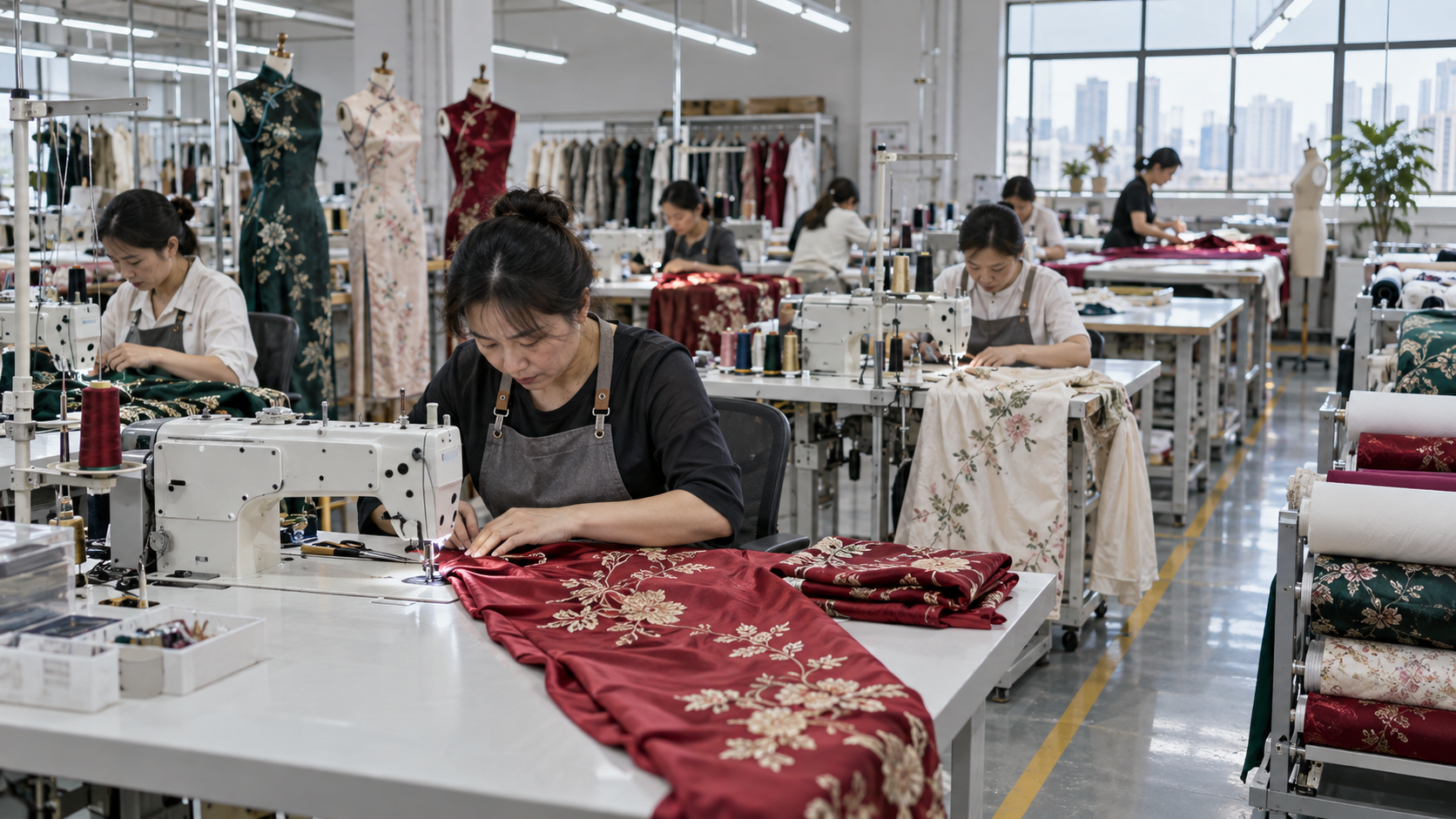
MOQ, sampling and delivery timing are among the first questions a buyer asks a custom qipao manufacturer. They are also connected: a lower quantity can affect fabric availability, a detailed sample can prevent bulk corrections, and a delivery date is only useful once the approval route is clear. This guide explains how to plan the three together.
What does MOQ mean for a custom qipao order?
MOQ means minimum order quantity, but it should not be treated as one fixed number for every project. In apparel manufacturing, the workable quantity depends on the style, fabric source, color, embroidery, size mix, labels and packing requirements. A simple qipao using an in-stock fabric may be viable at a different quantity from a style that needs custom jacquard, a special dye lot or individually positioned embroidery.
For buyers, the useful question is not only “What is your MOQ?” It is “What quantity is practical for this specification, and what changes if we adjust the fabric, color count or decoration?” That question gives a factory room to identify the actual constraint instead of providing a number that later changes during sampling.
Factors that affect a practical MOQ
- Fabric availability: in-stock materials can reduce development risk; custom colors and exclusive textiles often have their own mill minimums.
- Colorways and sizes: one style in several colors creates smaller production runs per color. A clear size ratio helps purchasing and cutting planning.
- Decoration: embroidery, appliqué, piping and special buttons may have material or setup requirements that differ from basic sewing.
- Packaging: branded boxes, barcodes, hangtags and care labels can have separate supplier minimums.
A transparent quotation should state which assumptions support the price and minimum. If a buyer expects a later reorder, it is also worth discussing fabric continuity and whether approved trims can be reserved or reordered. No factory should promise permanent availability without checking the material source.
Send your style, estimated quantity and target market for an MOQ and sampling review.
Get a Quote ->Start with a buyer brief, not only a reference image
A reference photo is useful for silhouette and mood, but it rarely contains enough information for production. Before a sample is made, the buyer should define the product application: fashion retail, bridal, hospitality, gifting or an event program. That end use changes decisions around lining, opacity, movement, care, durability and fit tolerance.
A practical brief normally includes a front and back reference, target quantity, destination market, target price position, preferred delivery date, planned size range and any required branding. If the design has a high collar, side slit, frog buttons or embroidery placement, identify the non-negotiable details. If some elements are open to recommendation, mark them as flexible. This saves time during the material and pattern discussion.
Information to send with an initial inquiry
- Reference images or a technical sketch, including front and back views where possible.
- Expected quantity by style, color and size, even if it is an initial estimate.
- Fabric direction, desired hand feel and required care level.
- Target market and customer profile, especially when fit blocks or labeling rules matter.
- Required delivery window and destination so production and shipment preparation can be considered early.
For established brands, a tech pack is ideal. For a first collection, a concise one-page brief can still be enough to begin. The important point is that the factory understands the customer requirements before it commits to a sample route.
Use sampling as a controlled approval process
Sampling is not simply a visual exercise. It is the point where the pattern, material, measurements and construction become a production specification. A strong sample review checks both appearance and repeatability. For qipao, that includes collar balance, shoulder line, side seam shape, slit height, closure placement, piping width, lining behavior and decoration position.
Many buyers benefit from separating development into stages. A first prototype can confirm silhouette and proportion. A revised fit sample can confirm measurements and construction. A pre-production sample, made in the approved material and color where feasible, becomes the most useful reference for bulk quality control. Not every project needs every stage, but skipping approval should be a deliberate decision rather than an accident of timing.
Sample review checklist
- Compare key points of measure against the approved size chart, using the same method each time.
- Check the garment on a relevant fit model or mannequin, not only laid flat.
- Review fabric direction, shade, drape and transparency under normal use lighting.
- Confirm embroidery scale and placement on the actual garment.
- Record comments in one version-controlled approval sheet before the next step starts.
In factory testing, we also look for construction issues that may not be obvious in a campaign photo: puckering around piping, stress at closure points, alignment across a side opening, inconsistent seam allowance and trim stability. Small findings are easier to correct before materials are cut for bulk production.
Build a production timeline around approval gates
A production timeline should be based on decisions that must happen in sequence. Fabric and trim confirmation usually precede bulk cutting. A pre-production approval should happen before bulk sewing. Final packing requirements should be confirmed before finished goods are folded and carton quantities are set. The total time can vary, so a responsible schedule identifies dependencies instead of presenting one universal lead time.
For a buyer planning a launch, work backward from the in-market date. Allow time for freight, customs clearance, warehouse receiving, photography or merchandising, and a buffer for revision. If the collection is tied to a wedding season, hotel opening or event date, explain that at the start. The factory can then recommend whether the design scope and approval plan are realistic.
Typical decision sequence
- Brief review, feasibility discussion and preliminary quotation.
- Fabric and trim selection, pattern preparation and first sample.
- Fit and design comments, followed by revised or pre-production sample approval.
- Bulk material confirmation, cutting, sewing and in-process quality checks.
- Final inspection, packing confirmation and shipment preparation.
A buyer should avoid treating an unapproved sample date as a bulk-ready date. Any revision to fabric, measurements or embroidery after that point can change both material planning and production timing.
What to verify during production and before shipment
Good bulk control begins with the approved sample and a clear specification. During production, the factory can check workmanship, measurements, trims and appearance at appropriate stages. The buyer should agree how updates will be shared: for example, sample photos, in-process photos, measurement records or a final inspection report. The right level of documentation depends on the order and customer requirements.
Before shipment inspection, confirm the carton packing plan, individual garment presentation, quantity breakdown and shipping marks. If the destination has specific labeling or packaging rules, provide them early. The production team should not have to guess whether a barcode faces outward, whether a garment needs a polybag warning, or whether an invoice description must use a particular format.
For a custom garment order, the strongest quality reference is not a memory of the first sample. It is the approved sample plus the written specification used by sampling, production and inspection.
Plan the commercial side of the order
MOQ and lead time are not the only commercial variables in a qipao project. A buyer should understand what is included in the unit price, what is paid as development or sampling cost, and what may change if the bulk specification changes. A useful quotation distinguishes garment manufacturing from optional items such as custom labels, barcode tickets, special packaging, extra colorways, custom embroidery files and freight. This makes approvals easier for a buyer who must present a clear sourcing plan internally.
It is also helpful to separate a target retail price from an achievable factory price. The factory needs the intended fabric level, decoration complexity and packing requirement before it can recommend a practical construction. Asking for an unrealistically low price before the specification exists tends to create revisions later. A better approach is to explain the target market and price position, then compare two or three feasible material and construction routes.
Questions to clarify in the quotation
- Does the price assume a confirmed in-stock material, or will it change with a custom color or fabric source?
- Is the sample charge credited against a later bulk order, and what revisions are included?
- Which labels, tags, individual bags and cartons are included in the packing plan?
- What information is needed before the factory can book materials and begin production?
For international buyers, the shipment plan should be discussed as early as the production schedule. A factory can prepare export-ready packing, but the buyer or freight partner may need specific commercial documents, carton marks or booking deadlines. Installation preparation is not relevant to a garment order in the same way it is for equipment, but receiving preparation is: the warehouse needs accurate carton counts, size breakdowns and item identification.
Work effectively with an overseas production team
Distance does not prevent a well-run project; unclear decisions do. Agree one primary contact, one current specification and one approval method. When comments are made on a sample, use numbered photos or a measurement chart rather than informal references such as “make the waist smaller.” State the measurement point, the requested change and whether it applies to every size. This is more dependable for both the buyer and the sample room.
Time zones can make quick decisions harder, so group feedback into one consolidated file where possible. If several people must approve a collection, set an internal review deadline before the factory needs the decision. This reduces the chance that the production line waits for a late visual comment after fabric or trims have already been allocated. It also gives the buyer a stronger record if a future reorder needs to repeat the approved result.
During a first project, request evidence that answers real production questions: sample photos with scale, fabric and trim references, factory testing observations when relevant, in-process images and shipment inspection records. Do not ask for constant updates that do not change a decision. Ask for the updates that let you approve the next gate with confidence.
FAQ
Can a factory quote MOQ before the final design is complete?
It can provide a useful indication, but the confirmed minimum should reflect fabric, colorways, decoration and packaging. Ask which assumptions are included in the quotation.
Should I approve the sample before placing a bulk order?
For a new design, approving a sample is generally the safer route. It gives the buyer and factory a shared reference for fit, material and finish.
What is the most common source of production delay?
Late changes to fabric, fit, decoration or labeling can affect material procurement and the production sequence. Consolidated approval comments help reduce that risk.
What should a shipment inspection include?
It should be agreed per order, but commonly covers workmanship, key measurements, color and trim consistency, quantity, packing and visible presentation against the approved sample.
Conclusion
A workable MOQ, an approved sample and a realistic delivery plan are three parts of the same sourcing decision. The clearest route is to share your product application and customer requirements early, then document each approval before bulk production starts.
CTA: Send your reference images, target quantity and delivery market to request a custom qipao quote. Our team can review the practical sampling and production route for your specification.